Saturday, November 12, 2011

It's all in the fold!


In the chateau de Versailles, there is the salon of the Grand Couvert, part of the Queen's grand apartment(dining area for Marie Antoinette).


The rooms are very ornate , but those folded napkins are just amazing!


The lotus blossom is so exquisite....representing a time when meals were a ritual with much attention to detail.

No fast food foam cartons here! Just the lovely details of a formal dinner....tines down, of course! I urge you to slow down this week and enjoy a special meal. Buy some flowers, light a candle and fold your linen napkins in a clever shape! Remember, it is the celebration of the small things in daily life that really matter!

Sunday, November 6, 2011

Pillars of the Earth...

To quote Ken Follet, author of Pillars of the Earth-"...when things are simple, fewer mistakes are made. The most expensive part of a building is the mistakes"
The Minoan columns at Knossos were fairly simple in design, they did, however, reject tradition and reversed the equation making them smaller at the bottom and wider at the top to create the illusion of height.


The beautiful marble columns adorning St. Mark's Basilica in Venice were still fairly simple, they brought in variety by using marbles from all over the eastern Mediterranean and added elaborately carved capitols.

source

Throw some artisans into the equation and Ornamentation began to enter the scene.
The Duomo di Orvieto is an exuberant example of motif and carved ornamentation including the use of  rococo  based solomonic columns.


source

These carved columns from the Monreale Cathedral in Sicily are reminiscent of the moorish columns at Alhambra.


The next evolution of the column came through the introduction of caryatids.  Caryatid is defined as a support taking the place of a column. They began as female figures but later evolved to mythological supports.


"Proportion is the heart of beauty"-another quote from Pillars of the Earth and caryatids provided pleasing proportion to the exteriors of buildings.


source
Michael Hansmeyer has done some modern tweeks on the simple column using math to create beauty.


source

"Michael Hansmeyer is an architect and programmer who explores the use of algorithms and computation to generate architectural form. He is currently based in the CAAD group at ETH's architecture department in Zurich. He holds a MBA degree from Insead Fontainbleau as well as a Master of Architecture degree from Columbia University. He previously worked with McKinsey & Company, J.P Morgan, and at Herzog & de Meuron architects."(source)

Math and art once again, provide the pleasing proportion that Follet wrote about. Simple or adorned, these pillars of the earth are all works of art!

Sunday, October 30, 2011

Macabre Art...Revisited


Last year for Halloween, I did a post on ossuary art-macabre at  its best! During the plague, there were so many dead, they could not all be buried and the bones became an issue.


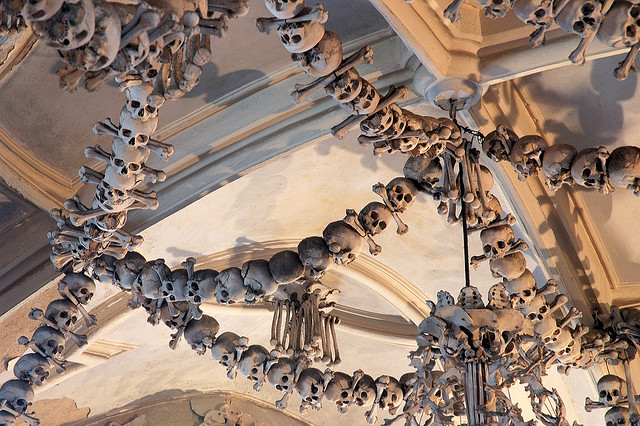
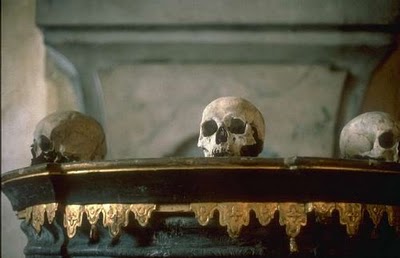
Near Prague, the Sedlec ossuary is a macabre display of human bones in decorative use.


Bones from the bubonic plague and later wars now decorate the walls of the ossuary.


...and ceilings


...and niches of the Sedlec chapel.


I think it was a dignified way to handle the situation. There is beauty and symmetry in the human form and the skeletal system.

Beauty...and art, can be found in many unexpected places! Happy Halloween!

Sunday, October 23, 2011

Orsini's Bosco Sacro....

Mask of Madness


The Park of the Monsters, or "Parco dei Mostri," in the Garden of Bomarzo was not meant to be pretty. Commissioned in 1552 by Prince Pier Francesco Orsini, it was an expression of grief designed to shock.
The Prince, also known as Vicino, had just been through a brutal war, had his friend killed, been held for ransom for years, and come home only to have his beloved wife die. Racked with grief, the Prince wanted to create a shocking "Villa of Wonders" and hired architect Pirro Ligorio to help him do so. (source)


Mouth of Hell

Salvador Dali visited the park and loved it He was so inspired, he shot a short film there, and the sculptures inspired his 1946 painting The Temptation of Saint Anthony. Jean Cocteau was also a fan of the park. Other artists followed, and a novel, libretto, and opera have all been based on the park.
When you visit the park and enter the "Mouth of Hell", there is a tongue upon which stands a picnic table and seating for a small group! (source)


Orsini was probably influenced by earlier works from temples, such as this one in Vietnam.

Or this Elephant Cave, a Hindu temple dating back to the 11th c. in Indonesia.


When I visited Carlo Marchiori's "Ca'toga", he has two monster gates that he constructed himself!


Here is a modern monster gate with clown features for a circus.


And when you see some modern interpretation and others think how clever they were, you will know the origins of their ideas!

Monday, October 17, 2011

It's all in the Lighting!


Lighting....it can make all the difference in our lives.


Shamir Shah NYSD

The objects we choose to display in our homes can be lost in the shadows or brought to the spotlight with the right lighting.


Larry Laslo

Notice how the shade disappears on this floor lamp. It draws the eye downward to the pop of color and the shell console table.


Even the style of lighting you choose can set a mood.

Matthew White NYSD


Uplighting can give a room height and drama.

Boaz Mazor NYSD
And downlighting can give a cozy mood.

Theresa Cheek

If you don't think lighting makes a difference.....


Theresa Cheek
Think again!

Sunday, October 9, 2011

The Chinese House....


The Chinese House is a garden pavilion in Sanssouci Park in Potsdam.


Trying to give culture to Potsdam, Frederick the Great  built the pavilion along with other chinoserie and rococo structures in the 18thc as an adornment to his flower gardens.


An exuberant example of chinoiserie, this pavilion was built in the height of the chinoiserie movement and featured an abundance of gilded figures and ornamentation.


This was also the time following the excavation of Pompeii and a love of ornamentation was all the rage.


The interior features all elements chinoiserie-exotic birds, ornamental parasols, palm trees and swags of fabric to tie it all together.


The gilded figures are in various positions drinking tea .

Other figures are musicians flanking the gilded columns that mimic palm trees.
If chinoiserie is a love of yours, this is perhaps the best example in existence!

Here is a video of the exterior-


Sunday, October 2, 2011

Alexander Hamilton

British born decorative artist Alexander Hamilton uses lime paints to create the illusion of Italian frescoes.

Alexander now lives between Florence and Siena with his family and paints and does restoration in private homes in the area.

His work is precise and based in traditional methods.


If you enjoy decorative painting, his website is a treasure!


These painted raw linen panels combine several techniques to achieve an authentic aged design.

(all photos are property of Alexander Hamilton)

Be sure to watch the video of the artist in action on his website!


Related Posts with Thumbnails